
It’s been five decades since the rehabilitation counseling program at NIU welcomed its first group of students. In October, alumni, current students, faculty and staff gathered to celebrate the work that has been done and the opportunities that remain ahead during a celebration luncheon at the Peters Campus Life Building. 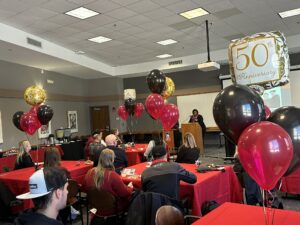
“This celebration was important as it allowed us to reflect on the legacy of our rehabilitation counseling program – 50 years of empowerment – while also envisioning our future growth,” said Shondra Clay, interim chair, School of Interdisciplinary Health Professions.
Following the luncheon, faculty planted an Autumn Brilliance serviceberry tree in front of Wirtz Hall to honor the 50-year anniversary.
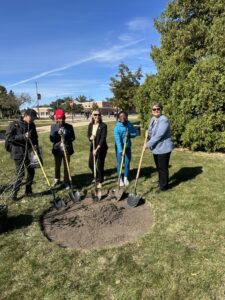 “Planting the Autumn Brilliance tree is symbolic of our program and community, representing resilience and adaptability,” said Clay. “This 50-year anniversary is a remarkable milestone, and we were delighted to have alumni, faculty and our current students come together to celebrate.”
In 1974, NIU launched a master’s degree program called deafness rehabilitation counseling. In 1981, it shifted to a master’s in communicative disorders with a specialization in deafness rehabilitation counseling. In 2016, it moved to what is now known as our master’s degree program in rehabilitation counseling. 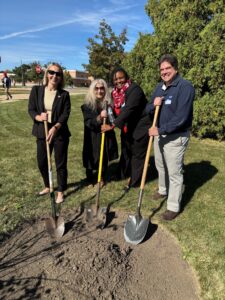
Rehabilitation counseling is a specialized form of counseling that prepares students to help individuals with disabilities achieve their personal, social and career goals. Rehabilitation counselors work with clients to develop skills, access resources and find support so they can live as independently as possible.
Amanda McCarthy, associate professor in the School of Interdisciplinary Health Professions, said that the rehabilitation counseling program has a long history in the community and continues to have some notable federally and state-funded initiatives.
“Current programs, like Huskies Building Effective Learning Opportunities and Network Guidance (BELONG), the Recovery Support Specialist (RSS) program – along with a well-established network of community organizations that serve as practicum and internship sites – enable our students to gain valuable experience while supporting individuals with disabilities,” McCarthy said. “All of these are examples of how our program continues to embody service for the public good.”
Rehabilitation counseling blends vocational support with psychological counseling. McCarthy said that initially, they focused solely on helping people with disabilities find employment. Over time, this shifted to a more holistic approach that included psychological counseling, social integration, advocacy, and independent living skills, addressing the full scope of an individual’s life, not just their vocational needs.
“Our rehabilitation counseling program has evolved and this is evident in our success with accreditation,” McCarthy said. “Through the leadership of current faculty and support from alumni and current students we are happy to be reaccredited for eight years, which is significant.”
Learn more about rehabilitation counseling at NIU.
