
What happens when you combine clinical education with puzzle-solving and teamwork under pressure? For graduate students in NIU’s Speech-Language Pathology (SLP) program, the result was a hands-on, high-energy learning experience that brought the principles of professional communication to life through an escape room event.

As part of their clinical practicum course, taught by Clinical Assistant Professor Deidre Dobbels, graduate students participated in a Professional Communication Escape Room designed to simulate the real-world complexities of healthcare communication. The challenge? Use active listening, clear communication, nonverbal empathy, cultural sensitivity, and interprofessional collaboration to uncover missing information about a fictitious client and provide appropriate services.
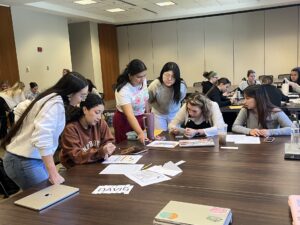 While it might sound like a game, the stakes and the lessons were serious.
“I think this activity showed how important communication and collaboration are when working on a team and with other professionals,” said first-year student Ashley Davis. “This is extremely prevalent in the speech-language pathology field, and the efficiency and effective communication between team members leads to better quality care for clients.”
The activity required students to not only solve problems, but also to recognize the value of every voice in the room. From reading subtle nonverbal cues to balancing competing ideas and perspectives, the experience echoed the dynamics of clinical settings, where effective collaboration is often the key to unlocking better outcomes for clients.
“It also showed how important it is to listen to other ideas and perspectives and lean on other people when you need help,” Davis added. “This can look like having professional, collaborative discussions with colleagues or reaching out to experts to gain insight on a particular topic.”
For Daisy Guerrero, also part of the first-year cohort, the Escape Room reinforced the power and pitfalls of team dynamics.
“One key takeaway from this activity is the importance of clear communication with team members,” she said. “Everyone brings unique perspectives, and sharing ideas openly can lead to more effective problem-solving.”
Guerrero noted how a lack of communication can lead to duplicated efforts or missed opportunities.
“It’s also essential to share key information; otherwise, you might end up trying to solve something that someone else has already figured out. This mirrors clinical practice, where one team member may already have valuable insight about a client that others are still trying to figure out.”
Inspired by creative teaching models, Dobbels brought the Escape Room concept back to her classroom after attending the annual convention of the Council of Academic Programs in Communication Disorders (CAPCSD). There, she connected with faculty from the University of Delaware—Kristen Palmer, Julie McCauley and Jacqueline Robinson—who are using similar experiential activities to prepare their students for the communication demands of clinical work.
By adapting this idea, Dobbels provided her own students with more than just a novel experience—she gave them a safe but challenging space to practice the interpersonal skills they’ll rely on every day as future clinicians.
As the healthcare landscape continues to emphasize team-based care, learning how to navigate the human side of communication is just as vital as clinical expertise. And for these SLP students, the key to success wasn’t just cracking codes—it was learning how to connect.
Learn more about SLP at NIU.
