Interprofessional education (IPE) isn’t just a trend it’s the foundation of high-quality, patient-centered care, and we’re proud to lead the way.
 IPE is a collaborative approach to learning that brings together students from two or more health professions to learn with, from and about each other in order to improve collaboration and the quality of care. In today’s complex health care environment, interdisciplinary and holistic practice is widely recognized as the hallmark of high-quality, patient-centered care. IPE plays a critical role in preparing students to work effectively in diverse, team-based settings by fostering mutual respect, enhancing communication and building a shared understanding of each profession’s unique contributions.
In CHHS, we deeply value interprofessional education as an essential part of training future health care professionals, and we are proud to offer a range of programs and initiatives that support this commitment.
In this article, we’ll be highlighting some of the recent initiatives and programming we’ve had this year. It started by identifying our IPE co-coordinators, Drs. Anitha Saravanan and Deana Herrman.
Dr. Herrman is a physical therapist who does research in the areas of disability studies and health disparities, and Dr. Saravanan is a nurse practitioner who researches the use of mindfulness interventions and technology to promote social/emotional support in patients with multiple chronic health conditions. In addition to cataloging existing IPE events, they spearheaded the development, planning and implementation of a half-day multidisciplinary event that included students from athletic training, audiology, marriage and family therapy, medical laboratory sciences, nursing, nutrition and dietetics, kinesiology, physical therapy, rehabilitation counseling and speech-language pathology. During this event, students heard from a guest speaker and were guided through a case presentation. In a grand rounds-style session, faculty members from a variety of disciplines discussed the case, highlighted the roles of different professions and highlighted interprofessional collaboration strategies that could be used to create a patient-centered treatment plan.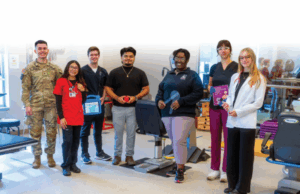
Our CHHS IPE team built on a foundation of other IPE activities that have been held in previous years. These include mass casualty and emergency care simulations that brought together athletic training and nursing students; screening events that involved students in audiology, physical therapy and speech-language pathology; a workshop on assessing suicidality that included students from audiology, physical therapy, speech-language pathology, nutrition and dietetics, nursing and nine other case study events. These case study events included a minimum of six CHHS disciplines and an individual with complex medical needs who was a full participant in the interdisciplinary team.
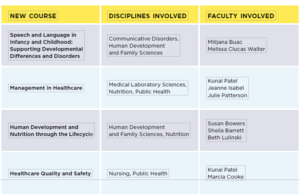
Building on the legacy of our existing IPE events, we are taking deliberate steps to embed interprofessional education more fully into the core curriculum of our academic programs. Rather than relying solely on cocurricular opportunities, faculty from multiple disciplines have collaboratively reviewed their existing course content to identify areas of meaningful overlap. This cross-program evaluation will allow us to integrate IPE into required coursework, creating sustained opportunities for students to learn with, from and about one another throughout their professional training.
These curricular redesigns represent a significant shift toward a more embedded and continuous model of interprofessional learning. Four interdisciplinary teams are leading CHHS in this endeavor.