
For many, volunteering means serving at a local nonprofit or community organization. For Corie Wild, an office administrator in NIU’s Department of Earth, Atmosphere and Environment, giving back means stepping into a nursing classroom to share a story of resilience, healing and hope.
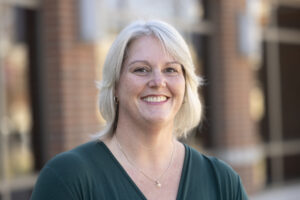
“I have an extreme amount of documented medical history from the time I was in high school being diagnosed with Crohn’s disease,” Wild said. “I’ve had three intestinal resections, a temporary ileostomy later made permanent, liver failure, chemotherapy medications, and numerous IV lines and ports. But with my background in communications, I’m not shy about sharing my story.”
Through Huskies Give Back, Wild found a meaningful way to serve by speaking to students in the College of Health and Human Sciences nursing courses about her experiences as a long-term patient and advocate.
“What I hope to give the students is an open forum to ask questions,” she said. “Where some might see my story as a sad one, I see it as exactly the opposite. Having medical setbacks doesn’t have to be the end of the world—it may very well be the beginning.”
Huskies Give Back encourages employees like Wild to live out the university’s core values of service and stewardship. Full-time employees can use up to 7.5 hours of paid time annually to volunteer in their communities, whether at a local nonprofit, their child’s school or right here on campus.
“Giving back doesn’t have to fit a mold,” Wild said. “Sometimes, the best way to serve is by sharing your own story.”
Earlier this month, she presented to a Medical-Surgical class and will return in November to speak again. Drawing from a lifetime of medical challenges, she offers nursing students a rare look at life on the other side of the patient-care relationship.
“Student nurses do not always get this opportunity in their clinical experiences in the in-patient setting of the hospital,” said NIU School of Nursing instructor Jennifer Sharp. “Corie shares her medical journey, the struggles and is very transparent and open to any questions. To bring to life what they are learning from the text and classroom is invaluable.”
Diagnosed with Crohn’s disease as a teen, Wild has undergone multiple surgeries and faced obstacles that would discourage most. Yet she describes her journey as one of renewal and empowerment. Now off all pain and antidepressant medications, she’s maintaining a 120-pound weight loss and is even training to become a pilot, having passed the Federal Aviation Administration’s most rigorous Class 1 medical exam.
“When they made the ileostomy permanent, they took away my pain and my excuses,” Wild said. “So I chose to live a healthier lifestyle.”
During her classroom visits, Wild shares practical insights into living with Crohn’s disease and an ostomy, a surgically created opening on the abdomen that allows waste (stool or urine) to exit the body when the normal path is blocked. She demonstrates aspects of day-to-day maintenance, discusses physical and emotional recovery and creates a transparent space where students can ask anything.
“Many doctors and nurses have no idea what recovery truly feels like,” she explained. “If I can help future medical staff understand a bit better, they can better support patients who are scared or uncertain about what comes next.”
For Wild, using Huskies Give Back to connect across colleges is about more than volunteer hours. It’s about community and compassion.
“What better way to give back than to support our own students?” she said. “We all have something unique to share: a story, a skill, or a life experience that could make a difference for someone else.”
Learn more about Huskies Give Back.
