
The holidays were a little brighter for residents at two local long-term care facilities thanks to a group of Huskies from the NIU student organization, Music and Memory. Both Lincolnshire Memory Care in Sycamore and Aperion Care in DeKalb were filled with smiles, laughter and the sound of music in December when residents performed a holiday concert for staff of their favorite tunes.
“The choir members had fun performing in front of an audience, and they enjoyed doing something kind for their staff/caregivers, which was very cool in and of itself,” said Jamie Mayer, professor of speech-language pathology and faculty advisor for Music and Memory.
The students paired up with residents to help them find the right lyrics, keep them engaged, and sing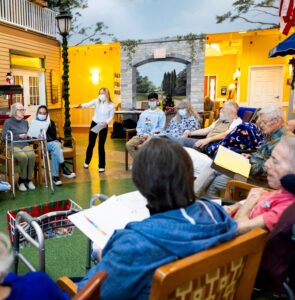 along with them. From “Silver Bells” and “Silent Night” to “Winter Wonderland” and “The First Noel,” it was a rewarding experience for all involved.
“Volunteering in different nursing homes for dementia patients (has been) a wonderful and fulfilling experience,” said Farah Almalayawi, a senior majoring in communicative disorders and Music and Memory club member. “Forming relationships with the residents has allowed me to make meaningful connections. The times we spent together can cheer and comfort them in the present moment, even though they might not remember me from visit to visit.”
Almalayawi said she appreciates the opportunity to connect with residents and has enjoyed her visits with them.
“I enjoy observing and celebrating minor successes and happy moments alongside the residents because it provides immense pleasure to me,” Almalayawi said. “These successes could be as little as exchanging a smile or having a good chuckle.”
 The purpose of NIU’s Music and Memory program is to further the mission of the national Music and Memory organization: to improve quality of life for individuals with dementia living in long-term care settings.
“Our program creates positive interactions for individuals living with dementia, while promoting students’ personal and career growth through experiential learning,” Mayer said. “The key to helping people who are living with dementia is to focus on their strengths.”
Mayer said that what neuroscientists have learned about memory over the last 70 years is that it is not a uniform function. There are different types of memories, and these are mediated by different parts of the brain. This is a critical idea to understand, Mayer said, because it means that even if one part of the brain is damaged, other parts of the brain and therefore other types of memories are spared.
“People living with dementia tend to have a lot of trouble with recent episodic memories because of the part of the brain most affected by the disease,” Mayer said. “But there are other types of memories, mediated by other parts of the brain, that are spared until very late stages.”
This includes motor memory, emotional memory and memories of their childhood.
“We can focus on these strengths as much as possible, using activities like singing or listening to familiar music or painting freeform art,” Mayer said. “These activities provide feelings of accomplishment, empowerment, and success because they are things they can do well.”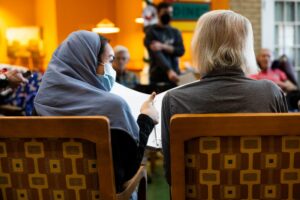
Mayer said music is particularly powerful because it engages the exact parts of the brain that are spared: motor (automatic) and emotional memory.
“We see the person with dementia reminiscing more, being more engaged, and/or communicating more during these activities,” Mayer said. “It’s easy to read about the way that music can reach someone with dementia, but seeing the magic in person really is amazing. One of the residents – who is typically unable to communicate in sentences – cried when we finished and told us how much she loved the songs.”
Learn more about Music and Memory at NIU.
