
For nursing students, learning to care for patients involves more than textbooks and lectures. At NIU’s School of Nursing, simulation gives students the opportunity to put their knowledge into practice, make clinical decisions and build confidence in a safe learning environment.
 That experience took center stage Sept. 14-18 as the School of Nursing celebrated Healthcare Simulation Week. The week provided an opportunity for students across NIU’s nursing programs to stop by, participate in activities, learn more about simulation and recognize the role it plays in their education.
“Healthcare Simulation Week is a wonderful opportunity to recognize and celebrate the people who make simulation possible,” said Jessica Madrigal, Human Patient Simulation Coordinator. “I am incredibly grateful for our simulation team and their dedication, creativity and commitment to creating meaningful learning experiences for our students.”
While the week celebrates simulation, Madrigal said the value of these experiences extends well beyond the simulation lab. Students use simulation to apply what they have learned, develop clinical judgment and practice making decisions in situations that mirror the complexities of patient care.
“Simulation provides students with a safe environment to learn to use knowledge, develop good clinical judgment, make decisions and learn from mistakes,” Madrigal said. “It also gives us an opportunity to recognize the dedicated simulation professionals, faculty, staff and leadership who work behind the scenes and support to make these experiences possible.”
Healthcare Simulation Week was open to all students in NIU’s nursing programs, giving students an opportunity to engage with simulation regardless of their program track. For Madrigal, that broad participation reflects the collaborative nature of simulation and the many people who contribute to creating meaningful learning experiences.
“Simulation truly is a team effort, and the impact we have on our students would not be possible without the collective support,” Madrigal said.
That support is also reflected in what students are expected to take away from their simulation experiences. Rather than simply completing a scenario or practicing a clinical skill, students are encouraged to clinically reason, communicate with others and apply their knowledge as they navigate complex situations.
“I hope students gain a greater appreciation for simulation and recognize that it is much more than simply completing a scenario or practicing a skill,” Madrigal said. “Simulation is an opportunity to think clinically, use knowledge, develop good clinical judgment, communicate, collaborate and build confidence in a safe learning environment.”
Those skills are intended to carry beyond the simulation lab and into students’ future careers. Madrigal said the ultimate goal is for students to feel better prepared to care for patients and more confident when faced with challenging clinical situations.
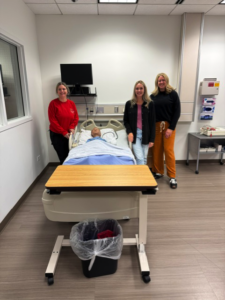 “Ultimately, we want students to leave simulation experiences better prepared to care for their patients and more confident in their ability to navigate complex clinical situations,” Madrigal said.
Learn more about nursing at NIU.
