
A salad can tell a story that stretches far beyond the kitchen. For students in a Northern Illinois University honors seminar, preparing food has become a way to explore how war, geography and ingenuity have shaped what people eat today.
For senior nutrition major Michael Nelson, the course brings together two interests that might not initially seem connected: food and military history.
“I have thoroughly enjoyed many different aspects of this course,” Nelson said. “It has combined my passion for food with my fascination of war history.”
In Professor Melani Duffrin’s course, Cooking Under Fire: Food, War, and the Rise of Modern Nutrition, 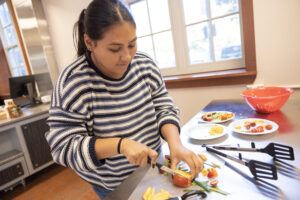 students explore the role food has played during wartime and how those experiences helped shape modern nutrition and food systems. The semester long honors seminar combines historical lessons with cooking and tasting experiences, giving students opportunities to connect what they learn in the classroom with hands-on activities.
“I love the combination of interesting, informative lectures in the classroom, and hands-on, exciting cooking experiences in the kitchen lab,” Nelson said.
The course was inspired in part by the University Honors program theme, “The Great Escape,” as well as Duffrin’s own family history. With two grandfathers and one grandmother who served in World War II, she grew up hearing stories from her mother and grandmothers about how food helped families make ends meet during difficult times.

“We often take the abundance of food choices for granted today,” Duffrin said. “Wartime shortages and rationing required families to be resourceful, and those experiences helped shape the food systems we benefit from today.”
For freshman biological sciences major Aalyah Oaxaca, the course has offered a new perspective on the relationship between food and history.
“I’ve enjoyed how engaging Cooking Under Fire has been through the preparation of the foods we are learning about,” Oaxaca said. “I’ve grown to acknowledge the depth of food and its effects during the different wars the United States has been a part of.”
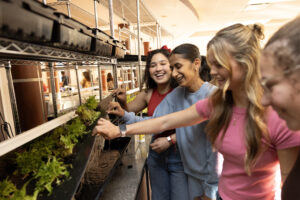
That history came to life during a recent class session in NIU’s Gardening, Research, Outreach and Well-Being (G.R.O.W.) Lab in Gilbert Hall. Students toured the hydroponic growing station, where guest speaker Professor Courtney Gallaher, NIU College of Liberal Arts and Sciences, explained how plants can grow without soil using nutrient-rich water.
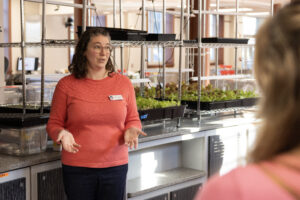
Gallaher also connected modern food production with World War II Victory Gardens. During the war, Americans planted gardens in backyards, schoolyards and community spaces to supplement food supplies, ease pressure on commercial food systems and contribute to the war effort.
For Nelson, the combination of historical perspective and practical experience has made the semester especially rewarding.
“I have gained a vast amount of knowledge about the chaos and challenges of war, from both the perspective of soldiers, and the civilian populations, through the lens of food, nutrition, and cooking,” he said. “It has truly been a wonderful experience.”
By bringing history into the kitchen and the garden, Duffrin’s course gives students a chance to see food as more than something on a plate. It is also a reflection of culture, a resource during times of crisis and a reminder of the generations whose sacrifices helped shape the food choices people have today.
Learn more about the University Honors program.
